Before i start, i want to introduce myself. My name is Muhammad Danish Harraz Bin Azlan. I am currently studying at UiTM Kampus Jengka Cawangan Pahang. I continued my studies in the field of Diploma of Accountacy(AC110). The purpose of me writing this blog is to introduce students about the UED102 also known as study skills. UED102 help student to improve their learning skills for them to adapt with university life. Its also expose students about method that will help them to study and learning better.
There 7 module in UED102 study skills which is: 1)Getting ready to learn
2)Goal settings
3)Time management and organization skills
4)Getting to know UiTM
5)Memory learning and improving concentration
6)Taking lecture notes
7)Academic integrity and performance
In our first class, we started our study skills class with an icebreaking session. This activity is to help student know each other better. The game that we were playing is called 'Mingle' where we need to gather others information such as colour clothing, hometown, birthday, sibling and contact number. We need to gather at least five person for each information.

This is what i get from the activity.
MODULE 1 : GETTING READY TO LEARN
To be a good students, we must have many soft skills such as:
1) Communication Skills
2) Job Interview Skills
3)Presentation Skills
4)Team Skills
5)Leadership Skills
6)Custromer Service Skills
7)Time Management Skills
After that, our beloved lecturer, Madam Sabariah Binti Jamaluddin ask us to list at least 10 differents between being a school students and a college students.
1)Knowledge in Writing
In school we use books but in college we just only use notes to write.
2)During Class Session
Many students in school will stay focus in their classes but not for college students that are always sleep in their classes.
3)Waking Up
School students need to wake up from sleep at least 6.30 a.m. but college students usually wake up in the afternoon.
4)Students Inventory
School students usually bring bag,books and pencil case to class but college students only bring notebook and one pen to their class.
5)Company
School student will always being accompany with their friends but college student always being alone.
6)Attendance
School classes will always full of student but college classes will always have some empty spot because their lack of attendance.
7)Guidance
In school, teachers will approach student if they believe you are falling behind but in college, if students need assistant, they should initiate contact with lecturer or Pembantu Akademik.
8)Responsibility
During school years, your parents and teachers will remind you of your responsibilities and help you manage them while in your college year, you must balance your responsibilities and set your own priorities.
9)Time Management
School student time is structured by their parents and teacher while college student manage their own time by themselves.
10)Test Difficulty
School test are easy but college test are very hard.

These are the three types of learning style.
There are way to know our learning style such as answering these question :

And this is how u count the answer for you to determined which style of learning did you prefer :

As you can see, my style of learning is Kinesthetic Style.
Based on the second page:
1)Visual learners need to see information. If your preferred style is visual, you have strong visualisation skills and can remember objects, shapes, and pictures. You learn by reading and by watching films, videos and demonstrations. You can see picture in your mind.
2)Auditory learners need to hear information. If your preferred style is auditory, you have a good eat and can hear differences in tones and rhythm. Reading out loud will be beneficial. You can remember everything that you hear.
3)Kinesthetic learners need to be physically activeand doing things. If your preferred style of learning style is kinesthetic, you are a hands of learner. You have a good coordination and learn by doing. You generally have an active approach to learning.

MODULE 2 : GOAL SETTINGS
What is goal ?
The definition of goal is it is something that we want to achieve i our life.
Purpose of setting goal ?
It is to fuel our ambition on what we want to get and achieve to get success.

Characteristics Of Effective Goal Settings
1) Specific
The goal should be clear and specific. It is to make us to feel more focus and ambitious to achieve our goal.
2) Measurable
It is important to have measurable goals, so that we can track our progress and stay motivated. It is to improve our focus toward our goal and the feel of excitement of getting closer to our goals.
3) Attainable
If we set a goal that we have no chance of achieving, you will only demoralise yourself and erode your confidence. So make sure it is possible to achieve our goal.
4) Relevant
Goals should be relevant. By keeping goals aligned with this, you will develop more focus.
5)Time-based
Our goal must have a deadline. This means we know when we should achieve that goal. When we working on a deadline, our sense or urgency increases and achievement will come at the right time.
Long-term and Short-term Goals
Long-term goal is the objective we want to achieve in a long time like a year or even lifetime.
Short-term goal is the objective we want to achieve in a short period of time.
Academic and Personal Goals
Academic goals is the objective that related to our work. As an example, student want to achieve great result in their test.
Personal goals is the objective that related with our daily life. As an example, we want to lose our weight from 90Kg to 65kg.
Few tips for a better headstart for every semester by Madam Sabariah
- Attend all classes
- Become an active learner
- Participate in class activity
- Get to know your lecturers
- Form a study group
- Stay up to date with your work
- Be receptive to change
- Work hard every semester especially first semester
My goal is i want to achieve deen's list for every semester and i can continue my degree at UiTM.
MODULE 3 : TIME MANAGEMENT
Time is indefinite continued progress of existence and events in the past, present, and future regarded
as a whole.
5 Tips for time management
Time is indefinite continued progress of existence and events in the past, present, and future regarded
as a whole.
5 Tips for time management
1) Daily Planner

2) Weekly Schedule

4) Academic VS Personal Life

5) Avoid Procrastination

Time Management Tips
- Eliminate distractions such as video games
- Be focused on the task at hand
- Use calendar
- Use a checklist so that we don't miss a thing
- Get organised
- Schedule rewards
- Get enough sleep
Advantage of Being Organised :
1) Focus
It will help us to gain more focus on what we want to achieve, both at work and at home. This will allow us to make better decisions.
2) Increase Productivity
We will be able to be more productive in your study. It is because we have more time to increase our productivity. Organised people are often twice as productive as unorganised people.
3) Better Time Management
By organising or prioritising what you do can better ensure that the tasks that are crucial get more priority. It is really simple, if you are more productive you get more done and therefore have more time.
4) Less Stressed
Generally, when our assignments and key dates are outlined for each class, we are better able to prepare and allocate your time accordingly, leaving you less stressed. When you are less stressed, we are able to focus and paying full attention to what we been doing.
5) Setting and Achieving Goals
Being organised and efficient will allow us to do more of what we want and what is important. Goal achievement in our job and personal life is extremely gratifying and gives a sense of accomplishment that cannot be valued.
6) More Energy and Enthusiasm
Organisation creates clarity which cam provide us with enthusiasm and energy.
7) We Can Prepare For Busy Weeks In Advance
As a college student, there are inevitably weeks when multiple tests occur or various projects are due, especially around midterms and finals. When this occurs, it is even more important to have a plan, so you can start studying enough in advance to be prepared for all your classes without the need for ineffective late night cramming.
PROCRASTINATION
The action of delaying or postponing our work. For an example, delaying our assignment is a serious problem among student nowadays.
Common Reason Why People Procrastinate


As a college student, there are inevitably weeks when multiple tests occur or various projects are due, especially around midterms and finals. When this occurs, it is even more important to have a plan, so you can start studying enough in advance to be prepared for all your classes without the need for ineffective late night cramming.
PROCRASTINATION
The action of delaying or postponing our work. For an example, delaying our assignment is a serious problem among student nowadays.
Common Reason Why People Procrastinate
- Lousy excuses
- Always think short-term
- Focus on the fear or pain
- Do not feel pleasure doing it
- Feeling overwhelming
- No strong reasons to take action
- Distracted
- Do not have energy
- Experience a lack of energy
- Unclear about how to get started
INTERIM STUDENT SCHEDULE
MODULE 4 : GETTING TO KNOW UiTM
FACILITIES:
Perpustakaan Al- Bukhari
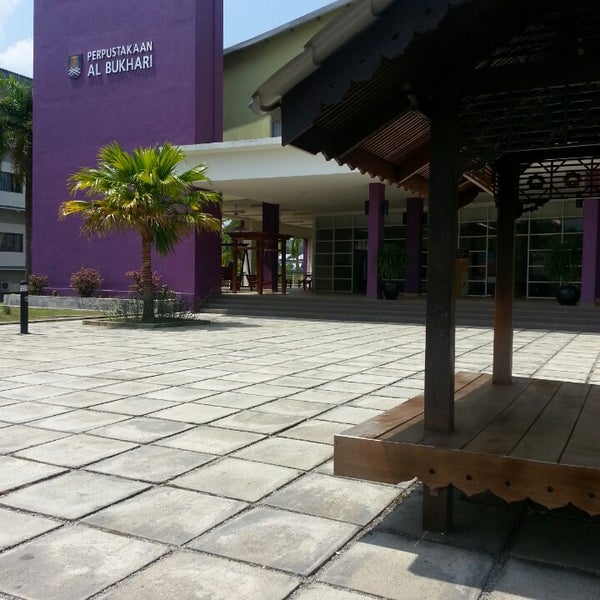
This is our library
Kolej Mat Kilau And Kolej Tok Gajah


Unit Exam

Hal Ehwal Pelajar

Masjid Uwais al-Qarni

Place for solat jumaat and kuliah
Me and my group has been given task to make a video about five important places in our campus. You can watch the video using this link on youtube:
https://youtu.be/44iozjYlbP4
MODULE 5 : MEMORY LEARNING AND IMPROVING CONCENTRATION
Meaning of Memory
MODULE 5 : MEMORY LEARNING AND IMPROVING CONCENTRATION
Meaning of Memory
- The ability to remember information, experiences and people.
Types of Memory
- Sensory Memory is the shortest-term element of memory. It is the ability to retain impressions of sensory information after the original stimuli have ended. It acts as a kind of buffer for stimuli received through five sense which is hearing, smell, taste, and touch which are retained accurately but very briefly.
- Short-term Memory have limited storage. The information must be repeated in order to get the information to Long-term Memory.
- Long-term Memory is obviously enough, intended for storage for information over a long period of time. Despite our everyday impressions of forgetting, it seems likely that Long-term Memory will decays very little over time, and can store a seemingly unlimited amount of information.

This is the stage of memory

This is the element in Learning Pyramid
The Causes of Poor Concentration
- Lack of attention
- Lack of interest
- Lack of Motivation
- Distraction from others
- Uncomfortable environment
How To Improve Concentration
- Get regular 'green time' by seeing green plants to release negativity
- Taking some break
- Redesign the environment that suits you
- Try brain training by playing games such as chess or crosswords
- Taking a good care of your health
What is SQ3R?

SQ3R is a comprehension strategy. It is a facility for students to think about text they are reading while they are reading. SQ3R help students to understand anything for the first time they read a text by teaching students on how to read and think like and effective reader.

MODULE 6 : TAKING LECTURES NOTE
What Is Note Taking?
- Note Taking is the practice of recording information captured from another source. By taking notes, the writer records the essence of the information, freeing their mind from having to recall everything.
Why Do We Take Lectures Note?
- Helps us pay attention in classes
- Helps us to study for quiz, test, and final
- Helps us improve our memory
- Helps us take ownership idea
- Helps us organise and process data and information
- Helps us engage our senses
- Helps the lecturers test students on how well they captured information given
How Do We Prepare For Class?
- Do pre-reading and homework
- Review syllabus
- Preview previous notes
- Look up key words prior to class
- Write the date at the top of notes
Physical Factors In Order To Get Better Note Taking Effect From A Lecture
- Avoid as much distractions from creaking doorways, windows, and whiteboard's glare and peers.
- Seating near the front and center because this can make sure that we have a clear vision and hearing.
How Do We Take Notes ?
- Date and label notes
- Make some space to write
- Use abbreviations and symbols
- Use our own Language
- Use and outline to show 3 things which is main ideas, supports and example
Effective Note Taking System (Cornell Method)
- The Cornell Method also known as Cornell note taking system or Cornell way is a note taking system devised in the 1940s by Walter Pauk, an education professor at Cornell University.
- Designed in response to frustration over student test scores.
- Meant to be easily used a test study guide.
- Adopted by most major law schools.
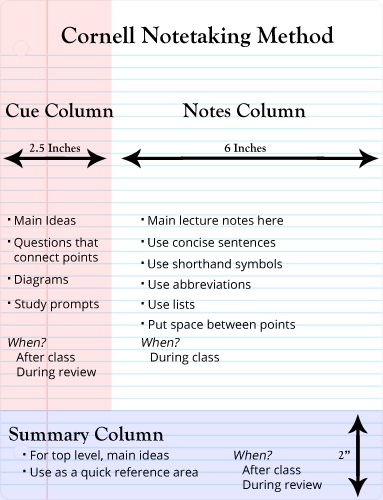
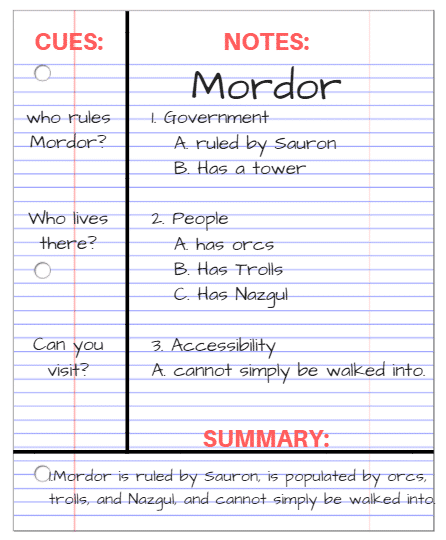
Examples :
What Is Academic Integrity ?
- Academic Integrity is the moral code of academy. This terms included cheating and plagiarism.
How Does UiTM Define Dishonesty ?

- Plagiarism - Intentionally using another person's writing or academic work and submitting it as your own.
- Failure to Comply - Failing to comply with the policies of the student's program or departments stated in publications.
- Falsification - Falsifying an exam, paper, project, application, transcript, or test using dishonest means or assisting another student to do so.
- Cheating - The acquisition of grades, academic credits, degree, honours, awards, certification or professional endorsements by means of cheating.
- Substitution - Substitution for another student, or permitting another person to substitute for oneself during an exam, course or on another work.
- Unauthorized Collaboration - Using materials or collaborating with another person during a test or assignment without authorization.
What Is Plagiarism ?
- Intentionally using another person's writing or academic work and submitting it as your own.
Where You Can Find APA Format ?
- APA Style is a writing style and format for academic documents such as scholarly journal articles and books. It is commonly used for citing sources within the field of behavior and social sciences.
Example Of APA Format :
- Dickinson, D.K. & McCabe, A. (2001). Bringing it all together: The multiple origins, skills, and environmental supports of early literacy. Learning Disabilities Research and Practice, 16, 186-202.
Performance
What is GPA ?
- GPA stands for Grade Point Average. It is standard way of measuring academic achievement in Univeristy and College.
What is CGPA ?
- CGPA stands for Cumulative Grade Point Average. CGPA is a grade pointing system used in the educational sector
How To Calculate GPA ?
- GRADE AND SCALE

- CGPA

- GPA

Example :


Answer :

That's all from me. Thank you

No comments:
Post a Comment